

News & Insights
ECAPS receives EIB financing to develop cutting-edge technologies for space and defence
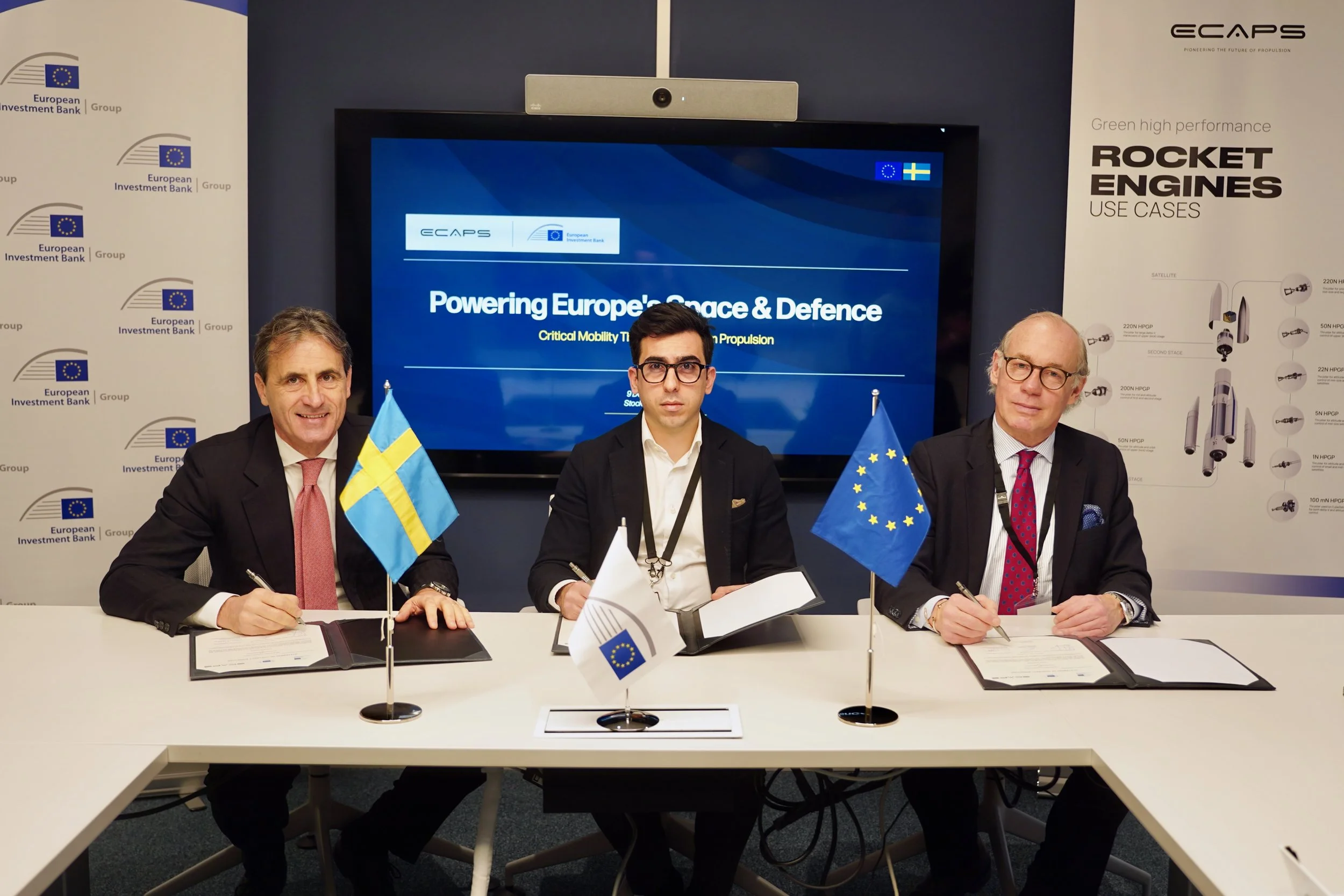
EIB lends Swedish aerospace company ECAPS €20 million to develop advanced propulsion systems for satellites and spacecraft
EIB financing also to cover technologies with civilian and defence uses
Deal marks first EIB loan to the space industry in Sweden
The European Investment Bank (EIB) is backing Swedish aerospace company ECAPS AB €20 million to accelerate the development of high-performance rocket engines and propulsion capabilities. The financing will also support advances in dual-use technologies, which can be deployed for both civilian and defence purposes.
The support by the EIB is through its TechEU initiative and takes the form of venture debt, a type of loan designed for high-growth startups and scaleups that provides additional capital without diluting ownership.
The goal is to bolster production of cutting-edge space technologies within the European Union and to enhance EU security.
The financing will contribute to ECAPS’s €47 million plan to scale its proprietary propellant and rocket engines, which are more efficient and cost-effective than traditional technologies. They also offer higher performance and safer handling compared to traditional hazardous solutions.
ECAPS intends to upgrade its testing facilities, develop new prototypes and prepare its engines for use on larger spacecraft and auxiliary systems. ECAPS will also use the EIB financing to continue developing systems for other mobility use cases, such as underwater vehicles and high-altitude platforms, expanding the commercial and security-related applications of the technology.
“ECAPS is exactly the kind of innovative European company our TechEU initiative aims to support,” said EIB Director of Equity, Growth Capital and Project Finance Alessandro Izzo. “By helping scale propulsion systems that can serve both civilian and security needs, we strengthen Europe’s technological resilience and contribute to the wider green transition.”
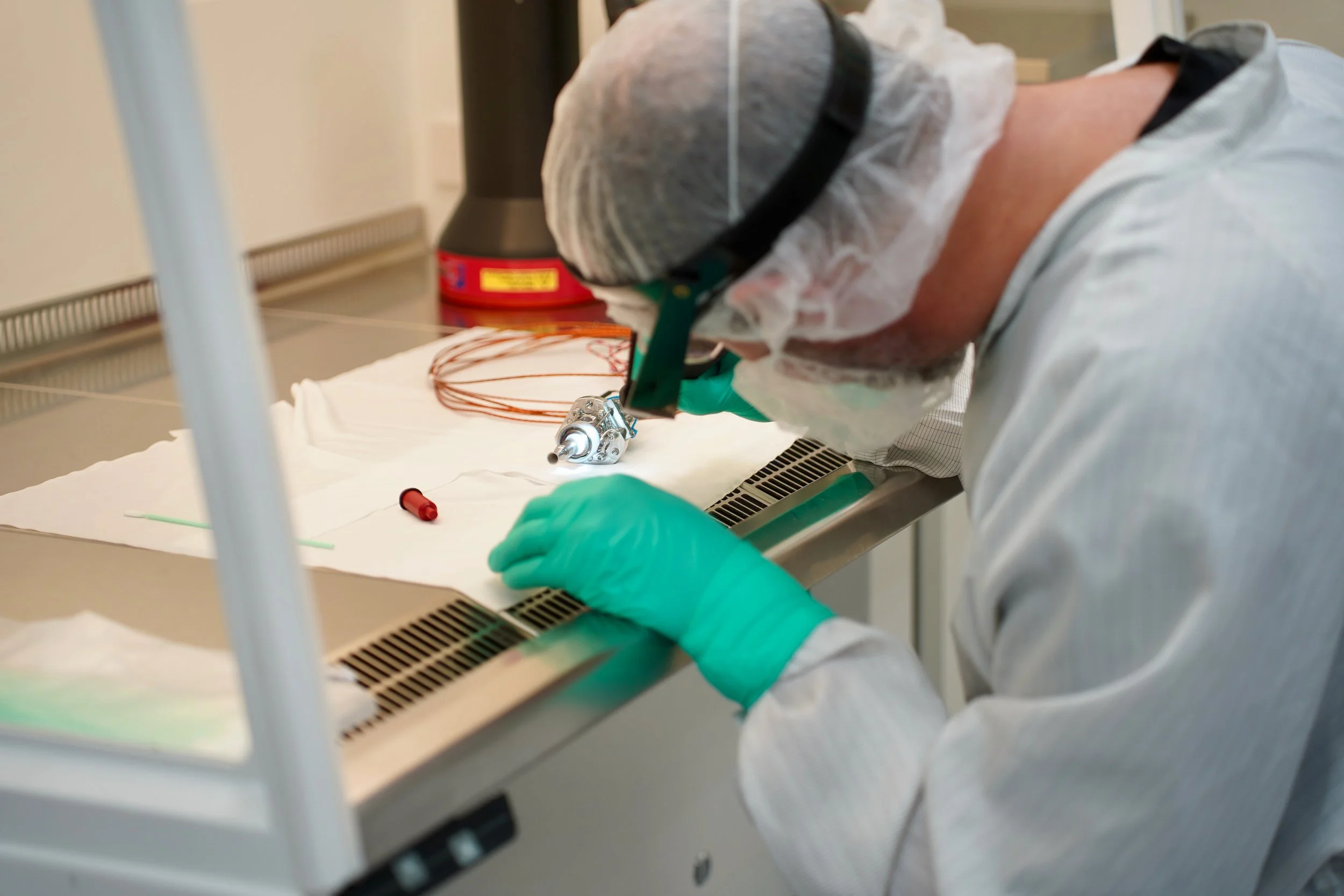
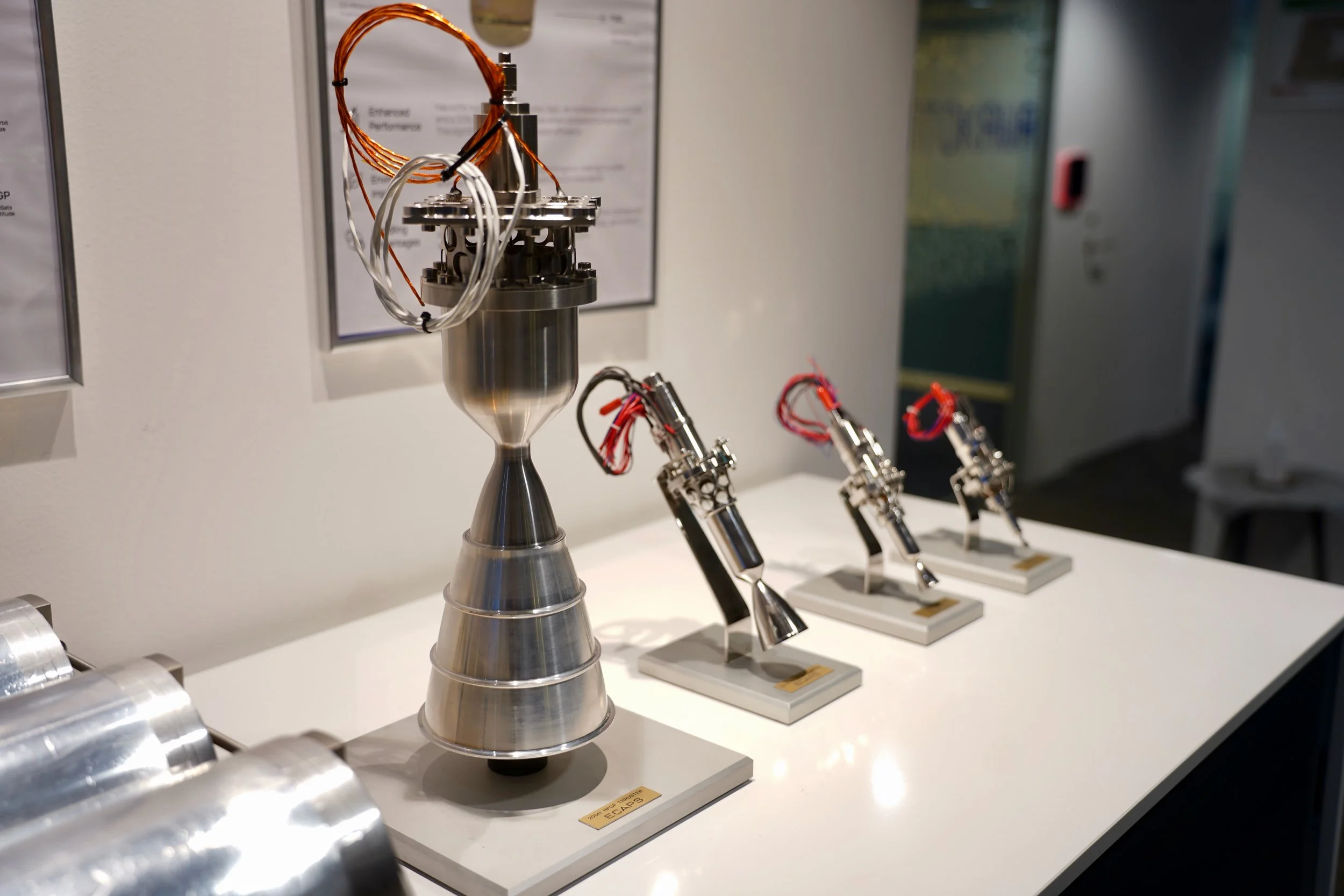
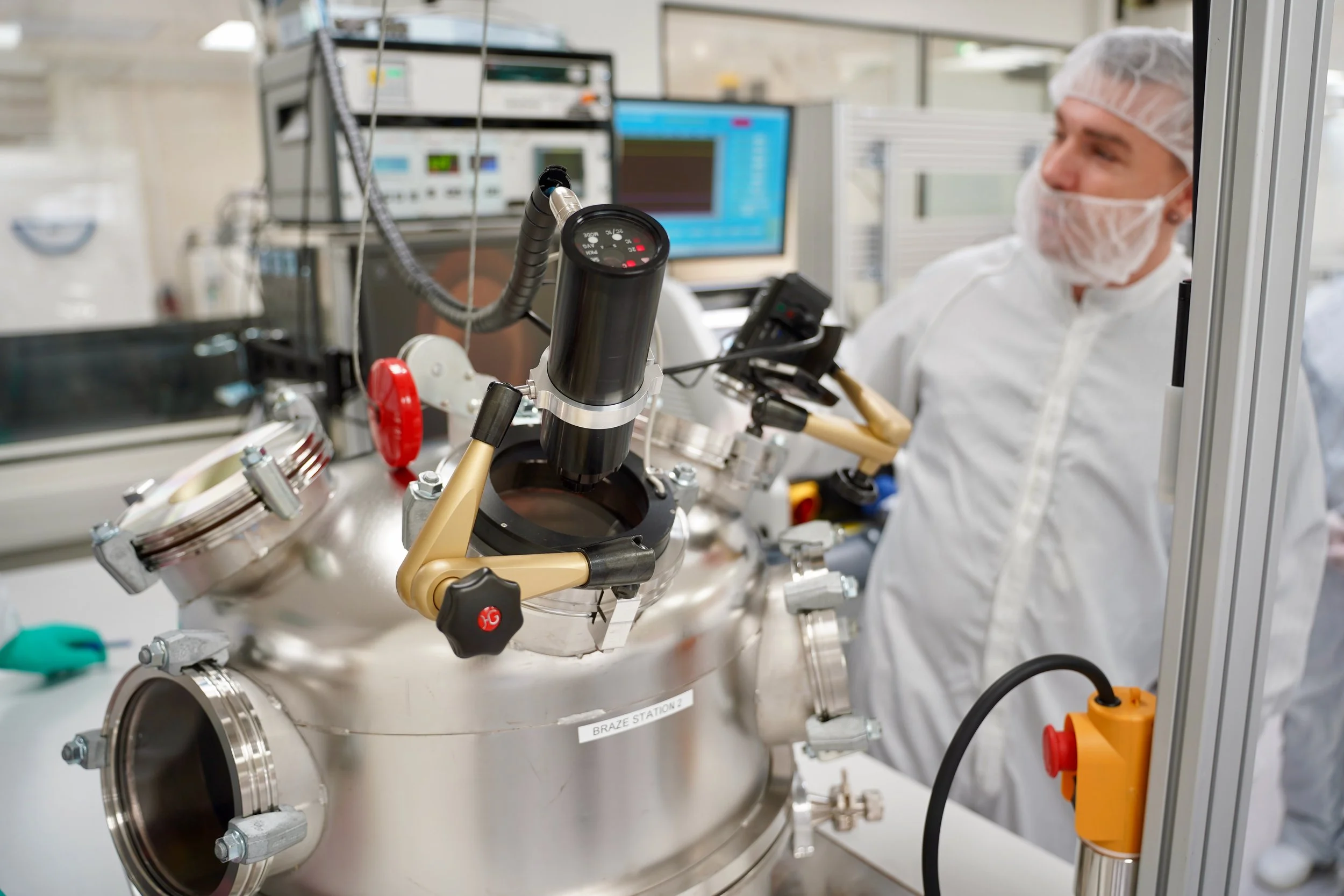
The agreement marks the EIB’s first loan to a Swedish space company and the bank’s first investment in non-toxic propulsion. By supporting the development of dual-use systems, the operation will help reduce EU reliance on non-European suppliers at a time when space capabilities are increasingly important for communications, Earth observation and broader security priorities.
ECAPS, which is based in Stockholm, has delivered innovations whose cumulative operational life in space totals almost two centuries.
“With a technological heritage that exceeds 190 years in space, ECAPS is equipped to continue supporting Europe’s strategic priorities in space and defence by advancing critical mobility technologies at scale,” said ECAPS Chief Executive Officer Odysseas Christofi. “As the geopolitical context around Europe remains unpredictable, this collaboration with EIB will be key to accelerate world-leading European innovation, and advance Europe’s collective ability to responsively deploy dual-use capabilities.”
The financing is backed by a guarantee under the InvestEU programme and supports EU policy priorities in the areas of space, security, defence and sustainability.
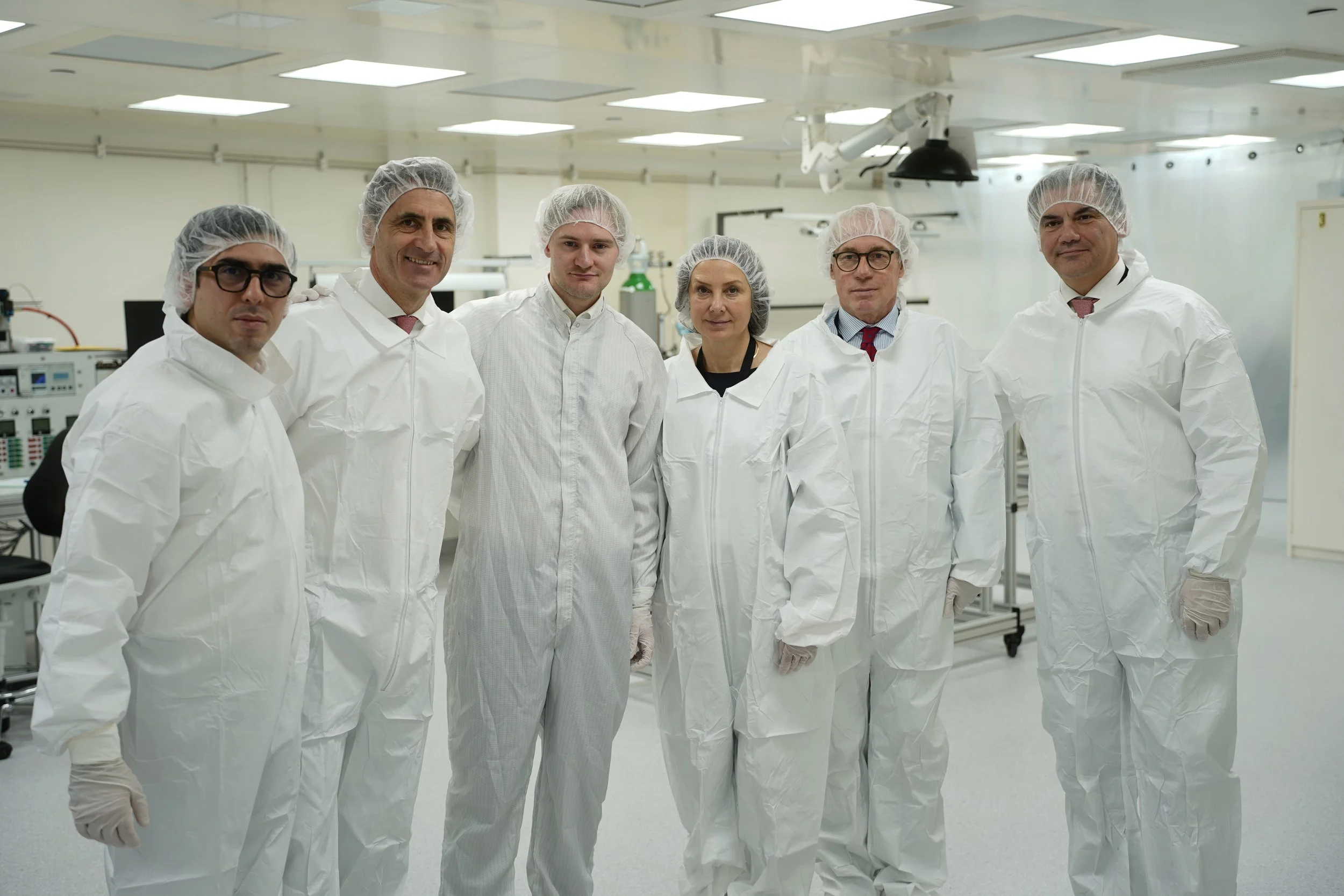
EIB visit to ECAPS' operational facilities in Solna, December 2025
Background
About EIB
The European Investment Bank (ElB) is the long-term lending institution of the European Union, owned by its Member States. Built around eight core priorities, the EIB finances investments that contribute to EU policy objectives by bolstering climate action and the environment, digitalisation and technological innovation, security and defence, cohesion, agriculture and the bioeconomy, social infrastructure, the capital markets union and a stronger Europe in a more peaceful and prosperous world.
The EIB Group, which also includes the European Investment Fund (EIF), signed nearly €89 billion in new financing for over 900 high-impact projects in 2024, boosting Europe’s competitiveness and security.
All projects financed by the EIB Group are in line with the Paris Climate Agreement, as pledged in the organisation’s Climate Bank Roadmap. Almost 60% of the EIB Group’s annual financing supports projects directly contributing to climate change mitigation, adaptation, and a healthier environment.
Fostering market integration and mobilising investment, the Group supported a record of over €100 billion in new investment for Europe’s energy security in 2024 and mobilised €110 billion in growth capital for startups, scale-ups and European pioneers. Approximately half of the EIB's financing within the EU is directed towards cohesion regions, where per capita income is lower than the EU average.
The EIB Group is a key provider of finance and advisory in the critical raw materials sector. Through its new CRM strategic initiative, it aims to invest €2 billion annually across the entire value chain, supporting the EU’s Critical Raw Materials Act and ensuring a secure, sustainable supply.
High-quality, up-to-date photos of the organisation’s headquarters for media use are available here.
About InvestEU
The InvestEU programme provides the European Union with crucial long-term funding by leveraging substantial private and public funds in support of a sustainable recovery. It also helps mobilise private investment for EU policy priorities, such as the European Green Deal and the digital transition. InvestEU brings together under one roof the multitude of EU financial instruments previously available to support investment in the European Union, making funding for investment projects in Europe simpler, more efficient and more flexible. The programme consists of three components: the InvestEU Fund, the InvestEU Advisory Hub and the InvestEU Portal. The InvestEU Fund is deployed through implementing partners who will invest in projects using the EU budget guarantee of €26.2 billion. The entire budget guarantee will back the investment projects of the implementing partners, increase their risk-bearing capacity and thus mobilise at least €372 billion in additional investment.
About ECAPS
ECAPS is the owner and global provider of HPGP solutions – the world’s only sustainable propulsion technologies capable of rapid-response applications and dual-use mobility in space. ECAPS designs, develops, tests, qualifies and manufactures its proprietary propellant, a diverse class of rocket engines, and complete propulsion systems from its facilities in Sweden.
With more than 190 cumulative years in orbit, ECAPS is a leading provider of Swedish-European propulsion solutions, powering critical mobility in space for commercial and government missions since 2010.
Press contacts:
EIB Group: Thomas Eriksson, Media Officer Sweden | t.eriksson@ext.eib.org
ECAPS: Alexandros Avgoustidis, Public & International Affairs Associate | info@ecaps.se
ECAPS Announces TYR-1: A Swedish–European Orbital Transfer Vehicle Demonstrator for Advanced Space Mobility
Stockholm, Sweden — November 19, 2025 — Building on 190 years of cumulative heritage in enabling critical mobility for international satellites and spacecraft, ECAPS is now expanding its propulsion capabilities to a new operational frontier. Today, the company announces TYR-1: a Swedish build Orbital Transfer Vehicle (OTV) demonstration mission that will showcase sovereign capacity for rapid respond and dual use orbital capabilities.
Started in 2024 and funded by ECAPS, the TYR-1 programme has been created to demonstrate ECAPS’ FAST propulsion architecture as the foundation for sovereign European orbital mobility. TYR-1 integrates ECAPS technology into a complete vehicle platform to showcase the full system-level capability it enables.
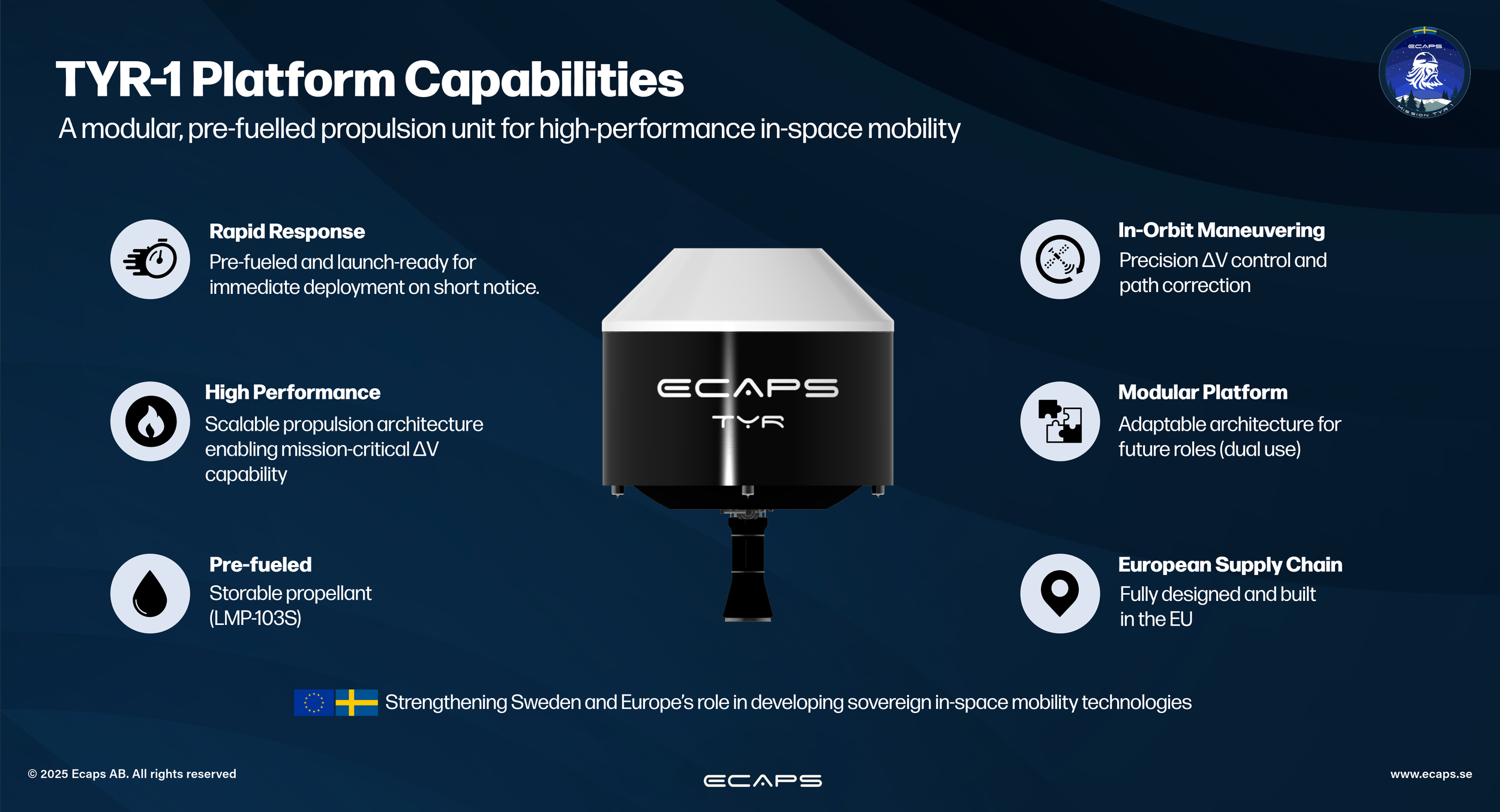
TYR-1 will be the first orbital vehicle powered by sustainable, high-performance chemical propulsion, representing a leap for Swedish and European international posture in spearheading innovation for space and defense. It is ECAPS’ most ambitious technology demonstration to date.
“With more than 190 years of cumulative on-orbit heritage, ECAPS is now demonstrating its technology at vehicle scale,” said Odysseas Christofi, CEO of ECAPS. TYR-1 is a step towards strengthening Swedish sovereign posture in developing orbital transfer capabilities built for diverse mission demands. Powered by our FAST propulsion architecture, TYR-1 is accelerating Sweden’s role in enabling European and Allied capacity for advanced orbital maneuvering in the next era of space operations.”
FAST Propulsion Architecture — Demonstrated in an OTV for the First Time
Throughout 2025, ECAPS conducted a series of tests to validate the effectiveness and performance of our proprietary HPGP innovations to power a future OTV demonstration:
ECAPS validated the Fast-Start Thruster (FAST) propulsion architecture after seven dedicated hot-fire campaigns on ECAPS 22N thruster. https://www.ecaps.se/news/snsa-awards-ecaps-contract-for-fast-start-up-thrusters-in-swedens-first-dual-use-program
ECAPS completed two 200N engine demonstration campaigns in November 2025, confirming the performance scaling path toward the 450N-class propulsion module that will power TYR-1.
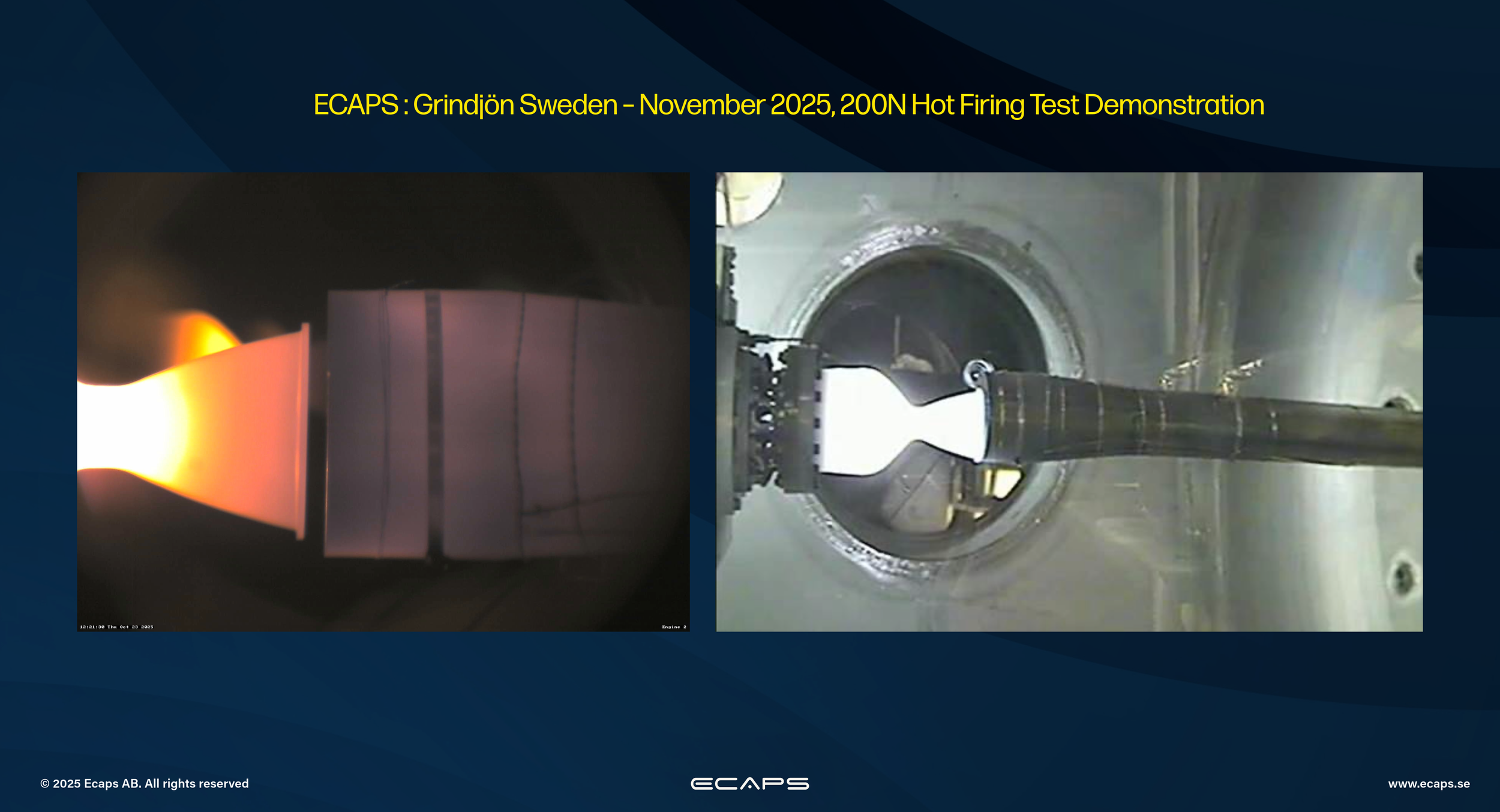
These achievements in research and development have laid the foundations for the TYR-1 demonstrator – the first mission to fly ECAPS’s advanced FAST architecture into a fully integrated vehicle.
A Sovereign Orbital Vehicle: Swedish Technology, European Supply Chain
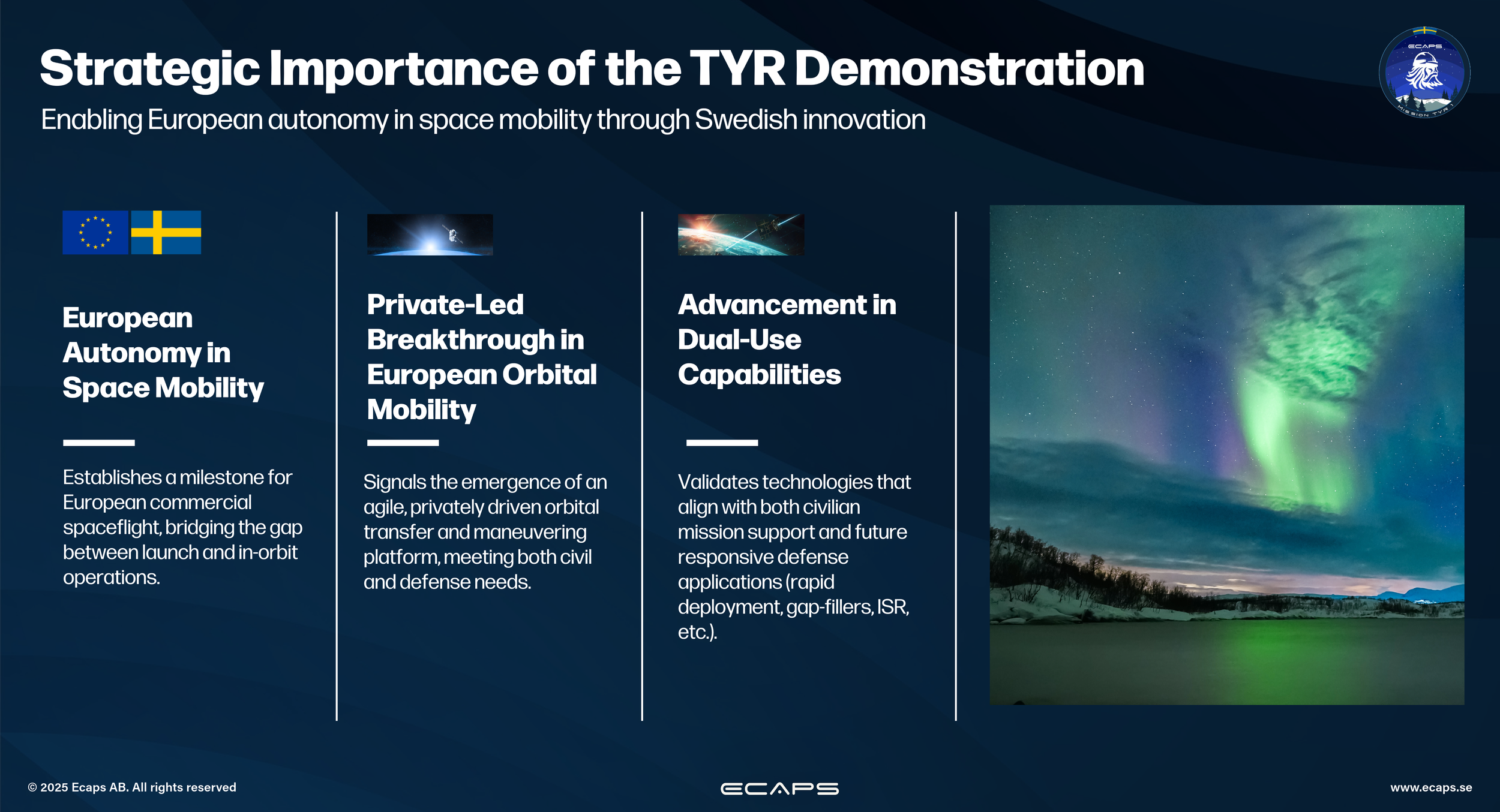
TYR-1 demonstrates a propulsion capability that is:
Designed, developed, and engineered in Sweden
Built through a secure, fully EU-based industrial supply chain
A Foundation for Future European In-Orbit Mobility
TYR-1 is the first entry in ECAPS’ next-generation platforms for orbital mobility, commercial services, and dual-use capabilities including:
Payload transfers
Orbital maneuvers, repositioning and optimization
Pre-fueled rapid-response operations
Advanced, high-precision mobility for emerging in-space logistical operations
The TYR-1 Demonstration Mission establishes the technological basis for a scalable family of future OTV capabilities.
Mission Timeline
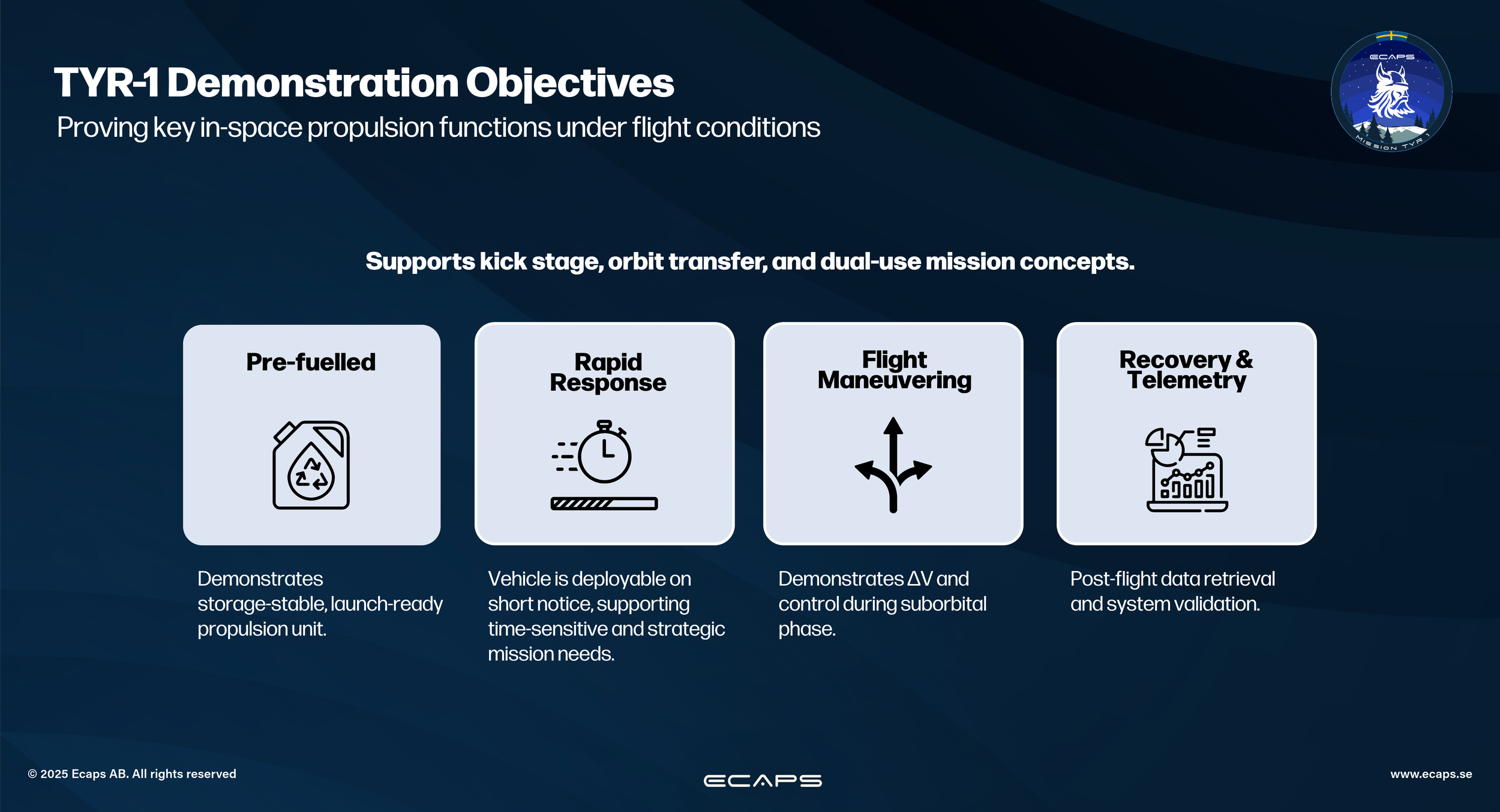
ECAPS will execute the TYR-1 Demonstration Mission through a structured, multi-phase campaign:
2027 — Suborbital flight demonstration
2028 / 2029 — Full orbital demonstration mission
This progressive build-up ensures a robust qualification path toward full OTV operational capability.
ECAPS is in the process of defining the TYR-1 demonstration site and associated service-provider arrangements. These will be formally announced at the beginning of 2026 as part of the programme’s operational roadmap.
ECAPS: Enabling Capabilities through International Partnerships
As the geopolitical context remains unpredictable and space critical mobility infrastructure is at risk, ECAPS is focusing on supporting European and Allied space industrial posture by developing sovereign propulsion capabilities.
In doing so, on 12 December, ECAPS will launch the world’s first Industrial Sovereign Propulsion Framework (ISPF) designed to empower Sweden and its security partners and allies with critical mobility capabilities for space and defense.
About ECAPS AB
ECAPS AB provides advanced propulsion technologies for commercial, governmental, and defense space applications. With more than 190 cumulative years in orbit, ECAPS is a leading provider of Swedish-European propulsion solutions for future space mobility.
ECAPS Marks 25 Years of Swedish Propulsion Innovation - Empowering Local Capabilities and Global Missions
Stockholm, Sweden – October 2025 — ECAPS AB, Sweden’s leading propulsion technology provider, celebrates its 25th anniversary, marking a quarter-century of innovation in spacecraft and defense mobility.

Since 2000, ECAPS has been advancing high-performance propulsion systems based on Swedish-invented Ammonium Dinitramide (ADN) technology with its LMP-103S propellant. With a complete HPGP portfolio encompassing various thrust classes and propulsion modules, ECAPS technology has powered missions across the globe, establishing a proven legacy of reliability, safety, and high performance.
Over the past two years, ECAPS has entered a new phase of expansion, scaling production capabilities, introducing new propulsion platforms, and forming long-term collaborations with international partners. The company’s focus is now on supporting capability development through local partnerships, ensuring that partners and allies seeking to strengthen their domestic propulsion and manufacturing capacity can do so with Swedish technology, transparency, and trust.
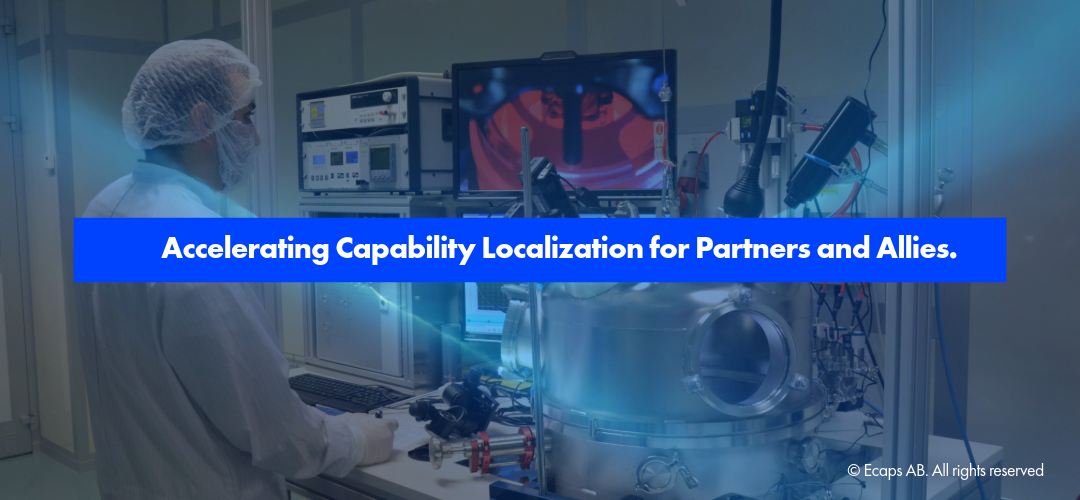
As part of this vision, ECAPS is launching a Capability Localization Program, providing structured access to propulsion technology, training, and integration support. The initiative highlights ECAPS’ commitment to global cooperation, enabling local capability development and advancing sustainable, high-performance propulsion solutions worldwide.
“For 25 years, ECAPS has represented the best of Global engineering — performance, reliability, and innovation,” said Odysseas Christofi, CEO of ECAPS AB”
“As we look ahead, our mission is to empower nations through cooperation and technology, building local capabilities while ensuring global access to advanced propulsion.”
With over two decades of proven flight heritage and collaborations with leading space agencies, commercial operators, and defense partners, ECAPS continues to shape the next generation of propulsion, uniting Swedish precision with global partnership and enabling future rapid-response missions.
About ECAPS
ECAPS AB is a Swedish aerospace and defense propulsion company specializing in high-performance ADN-based monopropellant systems. With over 25 years of experience and flight heritage across global missions, ECAPS provides propulsion technology, system integration, and capability development programs to partners worldwide.
For more information, visit www.ecaps.se.
SNSA Awards ECAPS Contract for Fast Start-up Thrusters in Sweden’s First Dual-use Program
Stockholm, Sweden – September 2025


The Swedish National Space Agency (SNSA) has awarded ECAPS with funding under the Dual-Use Space Technology Program, established by the Government’s Research & Innovation Bill (2024).
The grant will support ECAPS’s Fast Start-up Thruster (FAST) program, which has already demonstrated the capability to reach operational temperatures for its experimental 22 N thruster in under 48 seconds. ECAPS R&D will continue to expedite start-up durations to as low as 10 seconds, fully integrating the technology into engines by next year.
Broadening Sweden’s Mission Capabilities
ECAPS’s FAST innovation constitutes a critical technological breakthrough, as traditional thrusters typically require more than 20 minutes to preheat before being activated.
FAST is built for quick deployment and adaptability in diverse system types, including monopropellant and bipropellant, as well as systems like gas generators, Auxiliary Power Units (APU’s) and Emergency Power Units (EPUs). This ultimately enables mission flexibility, creating new possibilities for spacecraft maneuvering and orbital capabilities, while facilitating defensive applications, including Unmanned Underwater and Aerial Vehicles (UUVs, UAVs).
“FAST adds to ECAPS’s 15+ year heritage of delivering mission-proven HPGP solutions,” said Odysseas Christofi, CEO of ECAPS. “By making activation times almost instant, Sweden opens new commercial possibilities, while drastically enhancing its military preparedness.”
Background on ECAPS
ECAPS is a Swedish leader in advanced chemical propulsion systems, with over two decades of heritage in developing and delivering high-performance green propulsion. Building on the success of the LMP-103S propellant and a proven track record in orbital and defense missions, ECAPS pioneers next-generation propulsion solutions with a focus on sustainability, safety, and operational responsiveness.
For media inquiries, please contact info@ecaps.se
Strengthening Nordic–Japan Space Cooperation: ECAPS at Osaka Nordic Space Day
Osaka, Japan – September 2025
ECAPS participated in the panel discussion “Building Commercial Partnerships in Space” at Nordic Space Day in Osaka, an event bringing together Swedish and Japanese leaders to strengthen cooperation in space.

ECAPS highlighted Sweden’s role in propulsion, with its propulsion systems already deployed on important international missions supporting both defense and space applications.
The discussion also emphasized how infrastructure, launch services, and on-orbit technologies, alongside propulsion, are strengthened through international partnerships and localisation, ensuring capabilities can be adapted to support both civil and defense applications in Japan and beyond

Odysseas Christofi, CEO of ECAPS, joined by leadership from SSC, Astroscale, and Kongsberg Satellite Services (KSAT) on stage. The panel focused on unlocking opportunities for cross-border collaboration and commercial partnerships in the evolving space economy.
The agenda brought together leaders from government and industry, including Dr. Ella Carlsson, Director General at SNSA, who opened Nordic Space Day with welcoming remarks, and Sweden’s astronaut Marcus Wandt, now Chief Innovation Officer at Saab, who shared his perspective on international cooperation alongside JAXA astronaut Dr. Satoshi Furukawa. Contributions also came from Dr. Olle Norberg, Director General of the Swedish Institute of Space Physics (IRF), and Christian Hånberg, Head of Industrial Policy and Telecommunications at SNSA.
Other prominent participants included representatives from ESA, Andøya Spaceport, Beyond Gravity, Kawasaki Heavy Industries, and Kongsberg Satellite Services (KSAT), all contributing to panels on defense and security, launch services, and innovation. Together, these discussions addressed themes ranging from cross-border commercial partnerships to lunar exploration and the future of satellite-based services.
ECAPS thanks Business Sweden and the Swedish National Space Agency (SNSA) for their support in making Nordic Space Day possible, and for advancing Swedish–Japanese dialogue in space and defense.
Background on ECAPS
ECAPS is a Swedish leader in advanced chemical propulsion systems, with over two decades of heritage in developing and delivering high-performance green propulsion. Building on the success of the LMP-103S propellant and a proven track record in orbital and defense missions, ECAPS is strengthening Sweden’s position as a trusted propulsion authority for both European and international partners.
More on the Nordic Circle at the Nordic Pavilion.
ECAPS and ISE Collaborate to Demonstrate Auxiliary Power Unit (APU) Powered by ECAPS Advanced High-Performance Propellant LMP-103S

Location : Stockholm, Sweden / Port Coquitlam, Canada —Date : 29.07.2025
ECAPS and ISE Collaborate to Demonstrate Auxiliary Power Unit (APU) Powered by ECAPS
Advanced High-Performance Propellant LMP-103S
ECAPS AB, a Swedish propulsion company, and International Submarine Engineering Ltd. (ISE), a Canadian leader in unmanned underwater systems, are pleased to announce a collaborative demonstration of a high-performance Auxiliary Power Unit (APU) based on ECAPS’ LMP-103S liquid propellant.

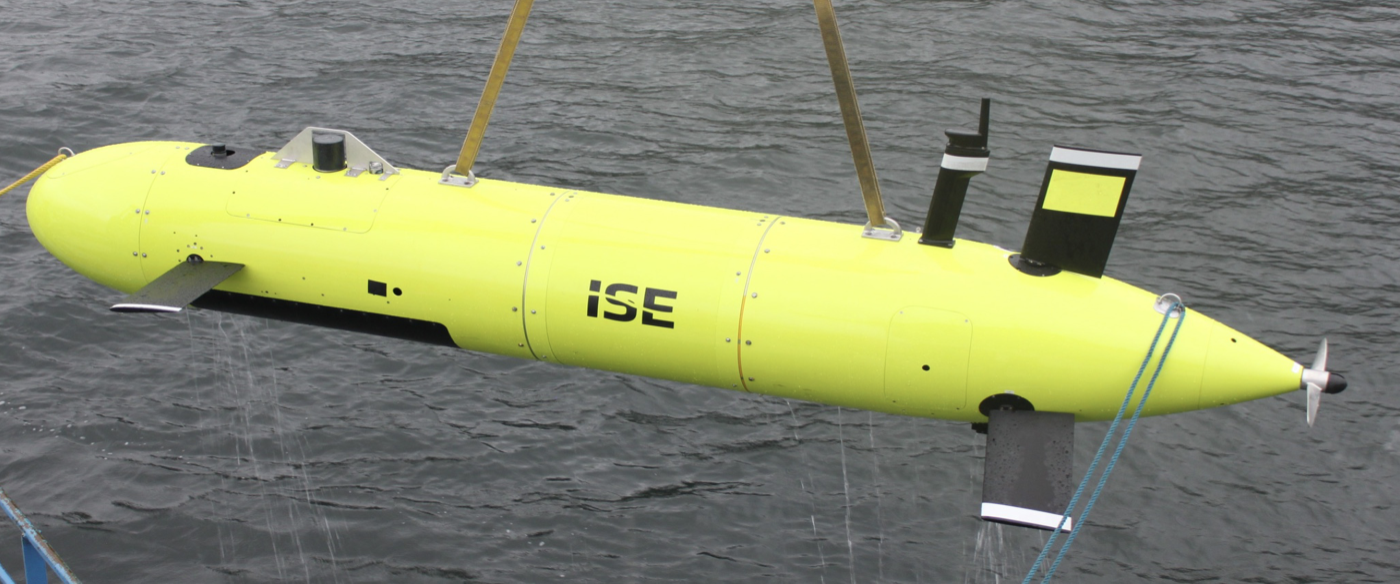
ISE AUV during sea‑trial operations in British Columbia – Photo © International Submarine Engineering Ltd. (Canada).
The APU is an evolution of ECAPS’ proven space propulsion technology, where LMP-103S has been successfully flown on multiple satellite missions. Now, ECAPS is extending the application of this propellant to deliver thermal energy up to 1100°C for auxiliary and onboard power. The formulation has been validated through five successful ground tests and is designed to support extended-duration, high-energy missions in challenging operational environments.
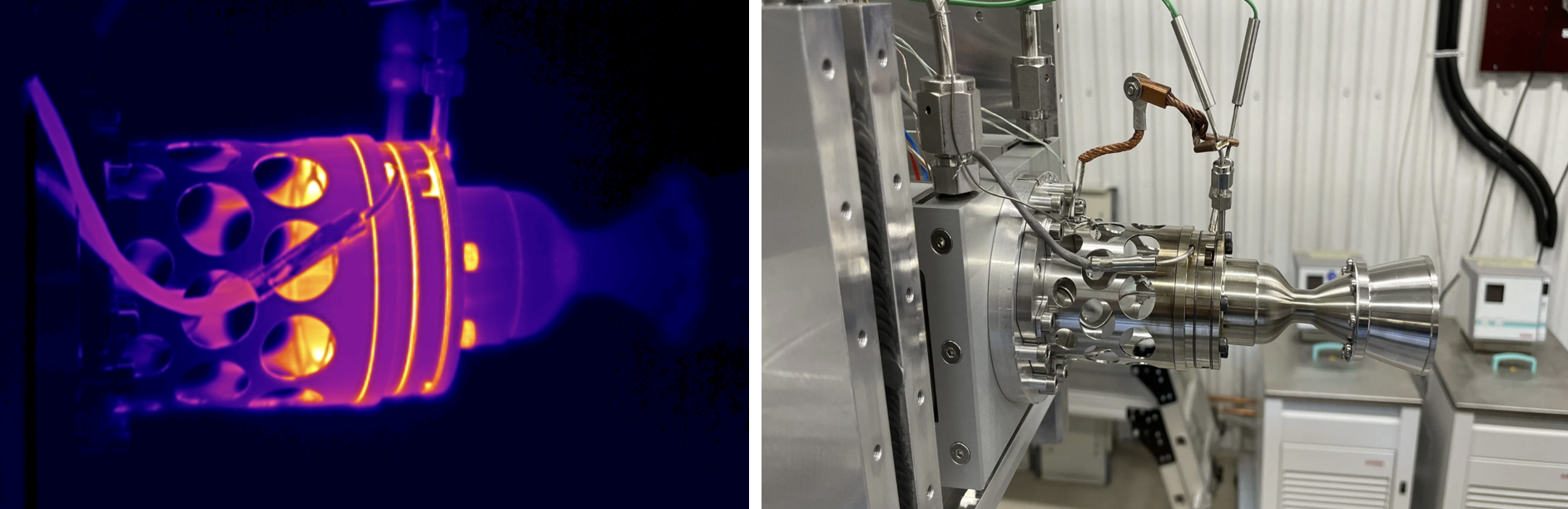
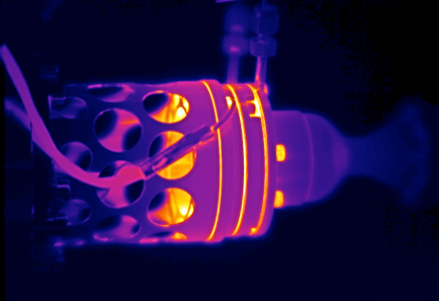
ECAPS 22 N FAST modular engine validating gas‑generator temperatures – Photo © ECAPS AB
LMP-103S is a storable monopropellant formulation that includes its own oxidizing agent, enabling combustion in the absence of atmospheric oxygen. This property makes it highly suitable for operation in vacuum, underwater, or other oxygen-deprived environments, offering a distinct performance advantage in autonomous and high-energy systems.
“We’re taking our flight‑proven LMP‑103S propellant from orbit to ocean. This demonstration shows how the same chemistry can recharge batteries, extend range and deliver burst power — all in one compact package.” - Odysseas Christofi, Chief Executive Officer, ECAPS
The demonstration, scheduled for Q3–Q4 2026 in British Columbia, Canada, will be led by ECAPS and conducted in collaboration with ISE. ECAPS’ APU will be integrated into an existing underwater drone platform provided by ISE, with only minor alignment and optimization required. The goal is to validate system performance in a real-world setting, demonstrating onboard battery recharging, extended operational endurance, and increased energy availability for higher-speed or power-demanding operations.
“ISE has always been focused on mission driven performance and innovation,” said Lara Smith, CEO of International Submarine Engineering Ltd. "We are excited to collaborate with ECAPS to validate this APU technology, recognizing its tremendous potential to enhance the mission capabilities of autonomous underwater platforms."
This demonstration represents a step forward in applying high-performance liquid propellant systems beyond orbit, into terrestrial and near-space domains where compact energy solutions are increasingly critical.
About ECAPS
ECAPS AB, founded in 2000 and based in Sweden, is a recognized leader in high-performance liquid propellant propulsion systems. The company developed LMP-103S, high-energy monopropellant that has flown on multiple spacecraft with an accumulated 176 years of time in orbit and a 15-year flight heritage, and is now being adapted for use in auxiliary power units, thermal systems, and compact energy platforms operating in oxygen-deprived environments.
About ISE
International Submarine Engineering Ltd. (ISE), headquartered on Canada’s west coast in British Columbia, with an east coast office in Nova Scotia, has been a pioneer and global leader since 1974 in designing and manufacturing advanced underwater systems, including autonomous underwater vehicles (AUVs), remotely operated vehicles (ROVs), and human-occupied vehicles (HOVs). Renowned for its industry-leading expertise, ISE delivers innovative solutions to government, defense, commercial, and scientific clients worldwide.
Media Contacts:
ECAPS AB
info@ecaps.se
International Submarine Engineering Ltd.
info@ise.bc.ca
ECAPS Demonstrates Breakthrough in Rapid Start-Up with 22 N FAST Experimental Thruster
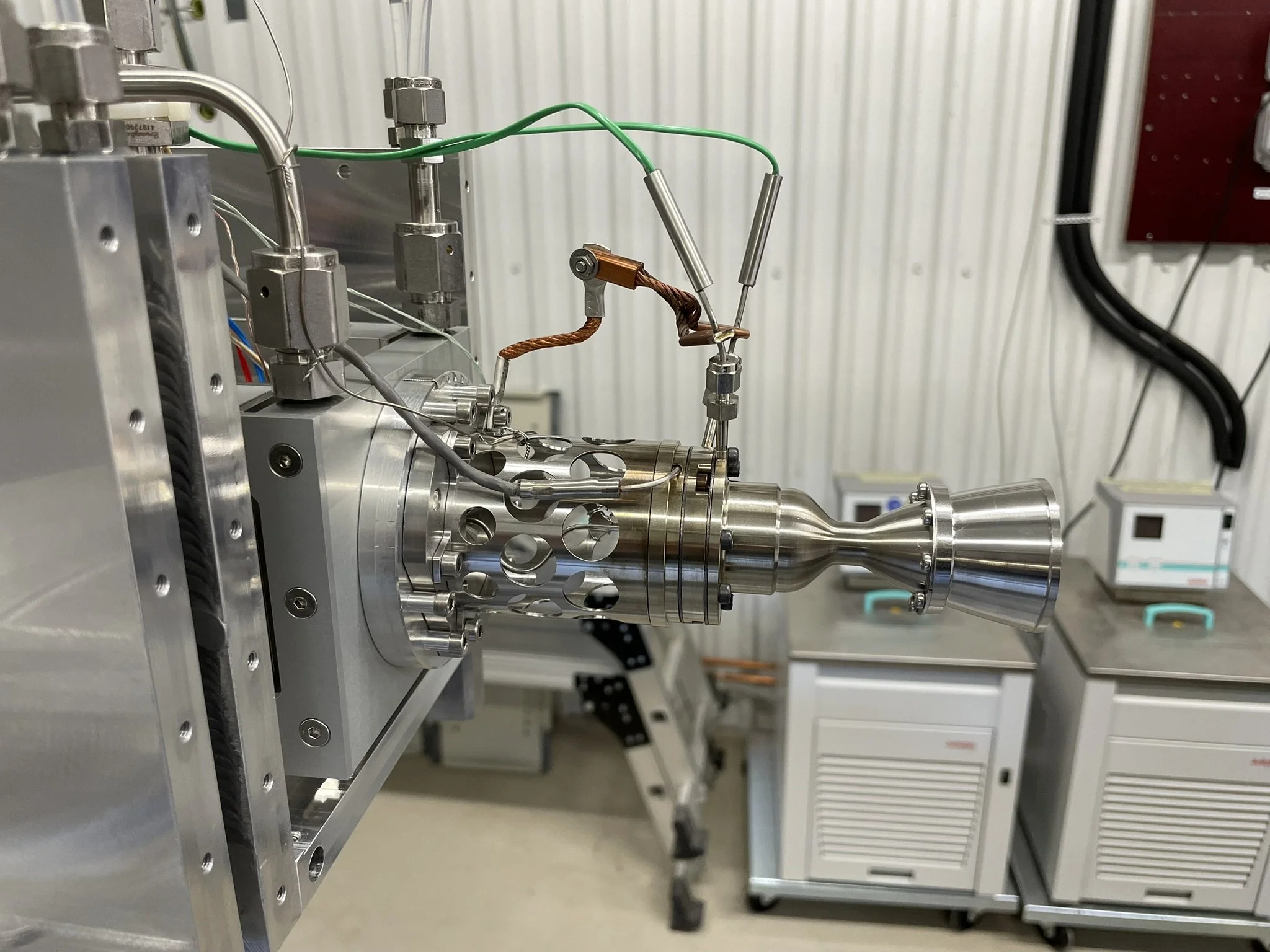
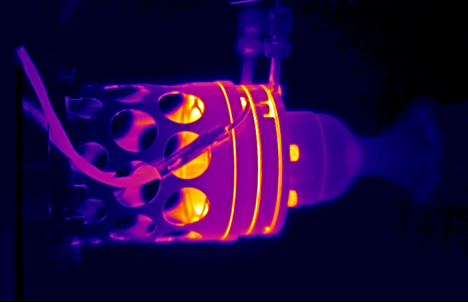
Stockholm, Sweden – May 5, 2025 – ECAPS has successfully completed another hot firing test of its 22 N FAST experimental thruster, achieving full start-up from ambient temperature to steady-state operation in under 48 seconds. This performance marks a significant advancement in the development of propulsion systems designed for rapid response and flexible mission readiness.
The test used ECAPS’s LMP-103S/LT formulation, with the catalyst bed starting at approximately 20°C. It was heated to its operational temperature of 350°C using ECAPS’ proprietary FAST start-up sequence, eliminating the need for prolonged electrical preheating.
Earlier ECAPS systems—such as those used on the PRISMA mission—required up to 30 minutes of electrical heating prior to thruster activation. The FAST architecture now achieves full readiness in well under a minute. Development work is ongoing to reduce this time further, targeting start-up durations as low as 10 seconds for reusable systems.
“This milestone reinforces our focus on pushing the boundaries of propulsion readiness,” said Odysseas Christofi, CEO at ECAPS. “By drastically reducing activation time, we’re enabling new mission profiles across both space and defense sectors that require rapid, on-demand performance.”
Versatile Architecture for Modern Missions
The FAST start-up technology is designed to be adaptable across a range of propulsion system types, including monopropellant, bipropellant, and gas generator configurations—giving mission designers more flexibility in choosing high-performance, fast-response propulsion solutions.
About ECAPS
Founded in 2000, ECAPS is a leader in green propulsion technology. Known for the development of the LMP-103S propellant, ECAPS is advancing next-generation propulsion solutions for space and defense, with a focus on responsiveness, safety, and environmental sustainability. For more information, visit ecaps.se.
For media inquiries, please contact:
info@ecaps.se
ECAPS Conducts Successful Test Unlocking New Applications for Bipropellant Thrusters and Gas Generators
Stockholm, Sweden – 18.11.2024 – ECAPS has successfully completed a critical hot firing test campaign of its LMP-103S derivative propellant at its testing facility. This campaign marks a major step in ECAPS’s expansion beyond monopropellant systems, demonstrating the application of its technology in bipropellant thrusters and gas generators, enabled by fast start-up technology.
The LMP-103S derivative, a well-established green propellant, was tested with the FAST test thruster in a series of 49 firings, including single pulses and pulse trains. This test validated the integration of the propellant with advanced propulsion systems requiring rapid response, precision control, and high reliability.
“This test campaign is a key milestone as we move beyond monopropellant systems into the realm of bipropellant thrusters and gas generators,” said Odysseas Christofi, CEO at ECAPS. “The integration of fast start-up technology with our proven propellant opens new applications for space and defense missions that demand enhanced flexibility and efficiency.”
The campaign demonstrated the system’s ability to achieve reliable and rapid ignition cycles, making it suitable for high-performance applications. The durability of the hardware and the comprehensive performance data collected affirm the readiness of these systems for complex mission scenarios.
Acknowledging the Team’s Contribution
The success of this test campaign reflects the expertise and hard work of the ECAPS team. “This achievement showcases the innovative spirit and dedication of our team,” said Kjell Anflo, Chief Designer. “Their commitment to advancing propulsion technology is central to ECAPS’s ability to explore new frontiers in propulsion applications.”
About ECAPS
Founded in 2000, ECAPS is a leader in green propulsion technology. Building on its success with the LMP-103S monopropellant system, ECAPS is now expanding into bipropellant and gas generator technologies to meet the evolving demands of space and defense industries. For more information, visit ecaps.se.
For media inquiries, please contact:
info@ecaps.se
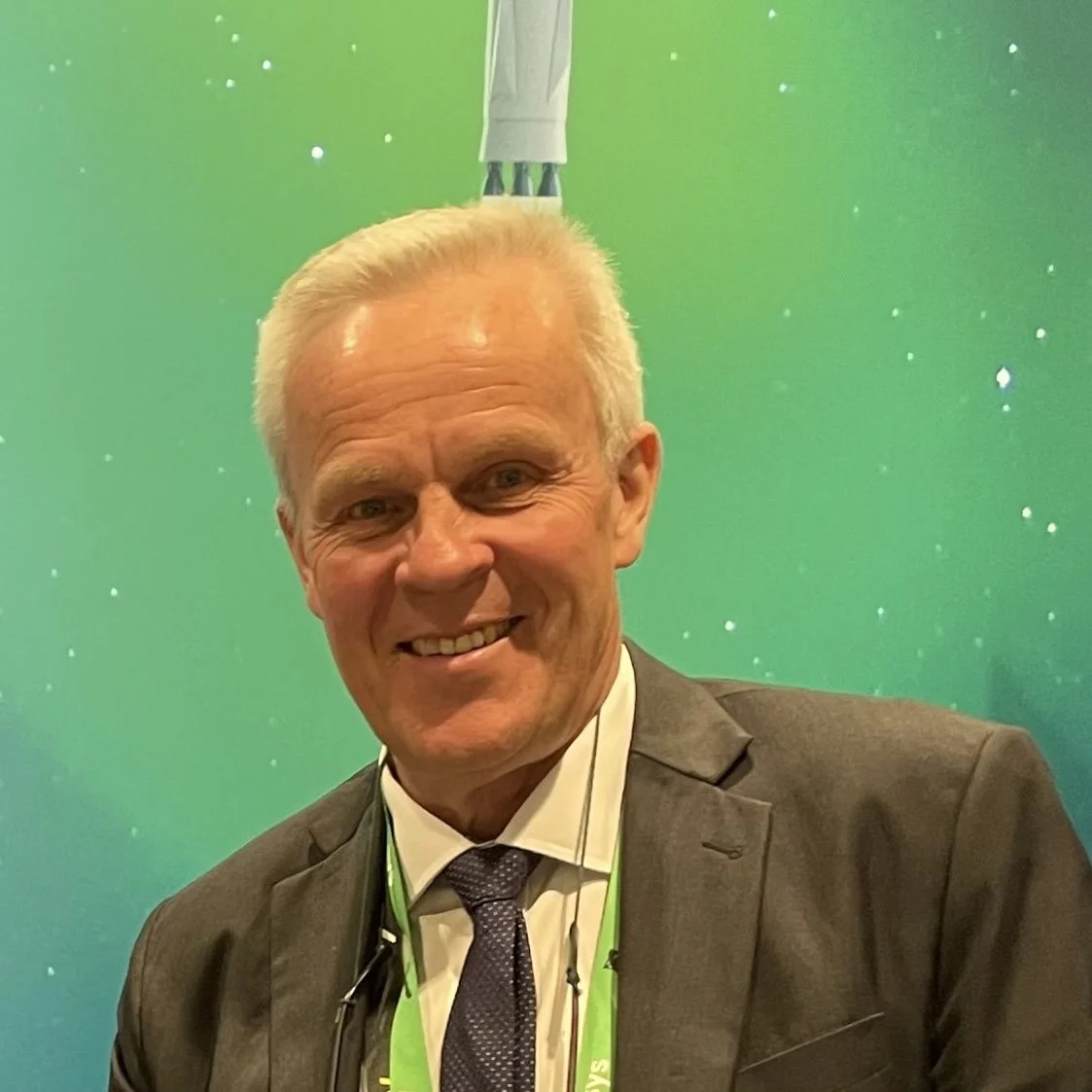
ECAPS Welcomes Stefan Gustafsson as Chairman of the Board
We are pleased to welcome Stefan Gustafsson as the new Chairman of the Board at ECAPS. Stefan brings extensive leadership and strategic expertise in the space and defense sectors, developed through his work across international markets. Most recently, he served as Senior Vice President at the Swedish Space Corporation, where he led Corporate Strategy and Strategic Security, focusing particularly on the U.S. market while also overseeing projects in Europe, Asia, South America, and beyond. From 2021 to 2023, Stefan chaired the European Commercial Spaceport Forum, underscoring his commitment to advancing innovation in the European and global commercial space industries.
Stefan’s distinguished career includes a notable tenure in the Swedish Armed Forces, where he held pivotal roles that contributed to national defense and security advancements. His professional influence is recognized through his membership in prestigious institutions, including the Royal Swedish Academy of War Sciences, the Royal Swedish Society of Naval Sciences, and the French Aerospace Academy. He is also an alumnus of the U.S. Naval Command College.
With Stefan’s insight, strategic expertise, and international experience, we look forward to advancing ECAPS' mission and strengthening our presence in the global space and defense sectors.
Announcement: ECAPS Attains NQA AS9100 and ISO 9001 Certifications
We are delighted to announce that ECAPS has successfully achieved the prestigious NQA AS9100 and ISO 9001 certifications, underscoring our unwavering commitment to excellence and quality in aerospace manufacturing and management.
This significant milestone underscores our dedication to upholding the highest industry standards and ensuring the utmost quality, reliability, and performance across all our products and services. By implementing robust quality management systems, ECAPS continues to set the benchmark for excellence in the space propulsion sector.
These certifications validate our steadfast focus on quality management, continual improvement, and customer satisfaction. Customers can have complete confidence in our processes, products, and services, knowing that they meet or exceed the stringent requirements of the aerospace industry.
At ECAPS, we remain steadfast in our mission to deliver cutting-edge, sustainable propulsion solutions that redefine the future of space exploration.
Oak Universe Completes Acquisition of ECAPS AB
Oak Universe AB is pleased to announce the successful completion of its acquisition of ECAPS AB on July 27, 2023.This strategic move marks a significant milestone in Oak Universe's expansion into the aerospace industry, showcasing its commitment to advancing cutting-edge technologies and driving innovation.
ECAPS AB is a renowned company specializing in the production of rocket engines and propellant for satellites and spacecraft. Recognized as a global leader in the development of non-toxic, "green" mono-propellant, ECAPS has positioned itself at the forefront of sustainable propulsion solutions for the fast-growing space industry.
"We are excited to announce the completion of the acquisition of ECAPS AB," said Odysseas Christofi and John Franklin, Founding Partners of Oak Universe AB. "This acquisition marks a significant milestone in Oak Universe's strategic expansion in the aerospace sector. By leveraging ECAPS's technical excellence in sustainable propulsion systems, we aim to drive innovation and accelerate advancements in sustainable propulsion technology. Together, we are committed to contributing to the growth and success of the space industry."
Under the new ownership of Oak Universe, ECAPS is poised for accelerated growth and continued success. Additionally, Oak Universe is thrilled to announce the appointment of Robert de Try as Managing Director of ECAPS. Robert brings extensive experience in the space industry, having previously served as the site director at ECAPS. His leadership will play a pivotal role in driving ECAPS's growth and strategic initiatives.
Reflecting on his new role, Robert de Try, Managing Director of ECAPS, shared his enthusiasm, 'I am truly excited to continue the development of ECAPS with its world-class team and the world's leading sustainable propulsion technologies, invented in Sweden. With access to Oak Universe's expertise and network, ECAPS will be able to further build upon the company's past successes. In my view, the future for ECAPS looks brighter than ever.'
Anticipating the road ahead, here stand some pivotal initiatives that will delineate ECAPS's trajectory in the forthcoming phases:
Market Expansion: ECAPS will capitalize on its established presence in the United States while exploring untapped opportunities in the European market. By enhancing marketing efforts, strengthening the brand, ECAPS aims to expand its market share in both the USA and Europe, driving the adoption of sustainable propulsion systems.
Product Development: Recognizing the increasing demand for propulsion systems in larger spacecraft, ECAPS will diversify its product offerings by developing new generation larger thrusters. This strategic move positions ECAPS as a leader in the industry and maximizes profitability by catering to the growing demand for advanced propulsion solutions.
Production Scaling: To meet the rising market demand, ECAPS will scale up its production capabilities. Through strategic investments, ECAPS will optimize manufacturing processes, streamline operations, and increase production capacity for thrusters and propellants. This initiative ensures timely delivery and customer satisfaction, supporting ECAPS's commitment to providing cutting-edge propulsion solutions.
300th thruster tested
Solna, Sweden - Jun 29,2022
Today, Wednesday 29th of June, ECAPS test team completed hot fire testing of our 300th thruster at our Space Test Centre at Swedish Defense Research Agency (FOI) in Grindsjön Sweden.
The 300th thruster was a 1N thruster which will be delivered to one of our many customers of our world class high performance green propulsion for satellite applications.
For more information, please contact: media@ecaps.se
ECAPS is 20
Solna, Sweden - November 28, 2020
ECAPS is celebrating 20 years in High Performance Green Propulsion. What began as a collaboration with SSC, Volvo Aero and the Swedish Government back in the mid 1990’s, was inaugurated as ECAPS company on 28th November 2000. Since then we have been developing and testing Green propellants, engines, systems and technology. Now, 20 years later, we continue to deliver products to our Worldwide customers with a class-topping range of high-performance thrusters, and expertise. Now part of Bradford Space group, the company is still based in Solna, Sweden where we started.
For more information, please contact: media@ecaps.se
ECAPS Celebrates 10 Years in Orbit
Private Equity in Europe
Stockholm, Sweden - June 15, 2020
On the sunny afternoon of June 15th 2010, a Dnepr rocket sat quietly in a Yasny missile silo. On board was the Prisma spacecraft, a Swedish technology demonstrator mission that was the culmination of five years planning and execution in Solna, Sweden. Prisma was a 190 kg combined satellite and target drone designed to investigate techniques for formation flying and rendezvous in low Earth orbit under autonomous control. The launch went ahead as scheduled at 14:42, releasing Prisma into orbit 16 minutes later.
This launch was significant for Bradford ECAPS as it included the first HPGP rocket engines on a spacecraft. Two 1N HPGP thrusters were fitted to the satellite to provide orbit maintenance throughout the mission.
When Prisma was launched, the 1N HPGP thruster was the highest performance monopropellant thruster in the world. Today, 10 years later, it still is. The technology demonstrated on Prisma continues, as further variants of the original 1N HPGP design are in continuous production and supplied to customers around the world.
SkySat Systems Ready for Launch
The Bradford ECAPS propulsion systems for SkySats 16 – 18 are fueled and ready for lift-off at Cape Canaveral Air Force Station USA onboard the SpaceX Falcon 9 Starlink 8 mission. Three other systems, for SkySats 19 – 21, will be launched later this summer on another SpaceX Falcon 9. For more details on this SkySat Block 3 mission go to Planet’s announcement SkySats 16-21 To Launch On SpaceX Falcon 9 Rideshare Missions.
The SkySat propulsion is a highly compact system originally designed by ECAPS for Skybox Imaging, now Planet. The SkySat spacecraft are powered by four 1N HPGP thrusters and ADN propellant, providing the highest performance in the liquid monopropellant market.
To date, 19 propulsion systems have been delivered to Planet of which 13 have been successfully deployed and are operating in orbit. Earlier successful launches in this series are:
• SkySat 3 – Launched in June 2016 from Satish Dhawan Space Centre, India (Antrix’s PSLV, C-34)
• SkySats 4-7 – Launched in September 2016 from Guiana Space Centre, French Guiana (Arianespace’s Vega, 007)
• SkySats 8-13 – Launched in October 2017 from Vandenberg Air Force Base, USA (Orbital ATK’s Minotaur-C, 010)
• SkySats 14-15 – Launched in December 2018 from Vandenberg Air Force Base, USA (SpaceX’s Falcon 9, 064)
1N HPGP Thrusters
Bradford Space and ECAPS continues manufacturing and delivery of the high performance (HPGP) 1N thruster for our satellite customers’ attitude and orbit control needs. We are happy to have a large number of these thrusters on order, in production and at the customer. These include:
• Preparatory activities for Moog’s first SL-OMV mission out of the United Kingdom with a scheduled delivery of 6 units in Q3, 2020. For more information about this mission, see Small Launch Orbital Manoeuvring Vehicle will Enable UK Launched Small Satellite Missions.
• Eight 1N HPGP High Throughput systems for the first Astranis micro-GEO mission. Targeting delivery by Q3 and ready for launch Q1, 2021 this program will feature an innovative combined HPGP / EP system.
• Twelve thrusters delivered to VACCO in Q4 2019 and the latest four have been delivered in March 2020 for use on Millennium Space Systems ALTAIR spacecraft.
• Four thrusters delivered to NanoAvionics in early May 2020.
• A double-capacity SkySat-like system is being engineered and built at Bradford Space in the Netherlands for York Space Systems, US, with a scheduled delivery in Q2, 2021.
Other Upcoming Missions Equipped with ECAPS Thrusters
• The Astroscale ELSA-d, launching in October 2020 (TBC), will have eight 1N HPGP thrusters.
• Fueling of the ArgoMoon subsystem, built by VACCO and powered by one ECAPS 100mN thruster with ADN propellant, is scheduled to be “fueled at the factory” at one of the ECAPS facilities in Sweden in Q4, 2020.
• One tailored SkySat system, comprising four ECAPS 1N HPGP thrusters on the Blue Canyon Tetra-3 mission for launch in Q1, 2021
For more information, please contact: media@ecaps.se
Six ECAPS Propulsion Systems Commissioned Into Service
November 21, 2017
Following the launch of six Planet SkySats on a Minotaur-C rocket from Vandenberg Air Force Base on October 31st, 2017, Bradford ECAPS announces the successful commissioning of all six propulsion systems from ECAPS, including firings of the 1 Newton maneuvering thrusters. This was confirmed through a series of tests and maneuvers conducted by Planet from November 7 to November 16. The successful launch, deployment and commissioning takes the number of successful spacecraft with ECAPS thrusters to 12 and the number of ECAPS thrusters on orbit to 48. The spacecraft constellation will be used to further Planet’s mission to provide geospatial information to its customers.
Said Mathias Persson, Business Director of Bradford ECAPS, the builder of the propulsion subsystems and thrusters “We are very pleased to see the successful commissioning of our subsystems. It is fantastic to see the fruits of all the hard work between our employees and our suppliers and, of course, our partner Planet”.
Said Pete Friedhoff, Propulsion Lead for Planet, “We’ve successfully completed commissioning of the newest six ECAPS systems on SkySat-8 through SkySat-13. The propulsion modules are healthy and performing nominally. I’m extremely pleased with the operational performance of the 11 ECAPS systems across Planet’s SkySat fleet.”
ECAPS’ High Performance Green Propulsion technology is an emerging choice by spacecraft manufacturers as an enhanced alternative to existing hydrazine based solutions. The system provides a unique high-density storage, is high-performant and, due to the low-toxicity and low sensitivity of the propellant, easy to transport and handle. These unique assets provide manufacturers and operators potentially profound savings through the elimination of launch-site fueling and enhancing overall spacecraft payload mass. In addition to further SkySats, ECAPS thrusters are slated to be part of satellite missions in the US and Asia to be launched in the next two years.
Upcoming Launch Represents a Major Milestone for Clean and Non-Toxic Spacecraft Propulsion
October 11, 2017
An upcoming launch of an Orbital ATK Minotaur-C rocket will be carrying six Planet SkySat earth observation satellites, each equipped with ECAPS-built (www.ecaps.space) propulsion systems. This will be the most significant launch to date for ECAPS ‘green’ high performance propulsion systems, which increases payload carrying capability for spacecraft builders while offering a high performance but non-toxic and easy and safe-to-handle solution to their needs. And while several orbiting spacecraft currently use ECAPS, such as the European PRISMA and previous elements of the Planet SkySat constellation, this will be the largest deployment to date of ‘green’ non-toxic spacecraft propulsion.
Most spacecraft to date have typically employed maneuvering thrusters which use hydrazine, a simple and effective but highly toxic and dangerous fuel. Handling and transporting hydrazine has typically been a very costly and dangerous activity, a fact that often makes space missions even more expensive and complicated than they already are. Special hazard suits, handling procedures, facilities and expensive special-purpose transport planes are common. ECAPS, however, uses a propellant blend (LMP-103S) that is so safe that it can be transported on commercial aircraft and be handled with only simple safety measures. In addition, the blend is higher density than hydrazine, a fact that helps ECAPS be more efficient than hydrazine while being cleaner and lower cost. The higher efficiency allows for spacecraft to have longer lives in space or carry larger payloads.
The ECAPS system was developed in Sweden by the company of the same name over the course of most of the last two decades. After incubating within the Swedish government-owned Swedish Space Corporation, ECAPS was acquired earlier this year and merged with Bradford (www.bradford-space.com), a Netherlands-based builder and developer of propulsion subsystems and attitude control systems. Bradford and ECAPS are both owned by AIAC, a privately-held US-based global industrial group.
Said Ian Fichtenbaum, Director of Bradford and AIAC’s space and satellite specialist: “This is truly an international collaboration of European and American companies and technologies coming together to make going to space an ecologically friendly endeavor. We are very happy to be involved in this ground-breaking technology”
The Minotaur launch is scheduled to occur October 31st, 2017 out of Vandenberg Air Force Base, California. Key members of AIAC, ECAPS and Bradford will be in attendance, in addition to teams from Planet and Orbital ATK.
ECAPS Performs “Green” Propellant Loading
September 26, 2017
Bradford ECAPS has now performed the first US “green” propellant satellite fuelling campaign within the Orbital ATK facilities at Vandenberg Air Force Base (VAFB) in California. During this campaign, six SkySats (Planet Labs Inc.) were fuelled with LMP-103S propellant. The propellant handling, including the loading of the satellites, was regarded as non-hazardous operations by the range safety. Only the dynamic gas pressurisation operations of the propulsion systems were judged as hazardous.
The fuelling operations were completed by a four-man crew within a seven day week from arrival to pressurisation of the last satellite. The crew was a team of personnel from Bradford ECAPS, MOOG and NASA. Only simple personal protective equipment (PPE) for handling of regular chemicals was used during the operations, while traditional propellants require so called SCAPE operations. The propellant was transported by a passenger aircraft from Stockholm Arlanda Airport, Sweden, to Los Angeles International Airport, which would be impossible for a Hydrazine propellant.
The six SkySats are scheduled to be launched from VAFB on an Orbital ATK Minotaur-C rocket on October 31. Bradford ECAPS is the result of a recent acquisition of the Swedish company ECAPS AB by the Bradford Holding Company Ltd., which is the controlling shareholder of Bradford BV in Netherlands.
ECAPS is known for their low-toxic, so called “green”, alternative to existing hydrazine based space propulsion solutions. The High Performance Green Propulsion (HPGP) technology includes the monopropellant LMP-103S and thrusters optimized for this propellant.
The HPGP technology is space proven by the PRISMA mission launched in 2010, followed by the launches of one SkySat from India and four SkySats from French Guyana during 2016.